I spent two days in London at the QS ImpACT Youth Summit at Imperial College London. The first day was the AI for Impact Challenge; the second was the Youth Summit itself.


Day 1: The AI for Impact Challenge
The challenge showed how young teams are applying AI to real problems in education, health and climate. More than 100 participants took part, representing many regions of the world, and the jury selected three projects for their clear pathways to impact:
- A wellbeing app that connects university students to local support networks in real time.
- A system designed to reduce unnecessary AI prompts and computational waste, lowering energy use and emissions.
- An AI-supported STEM enrichment platform that delivers consistent learning to students at home.
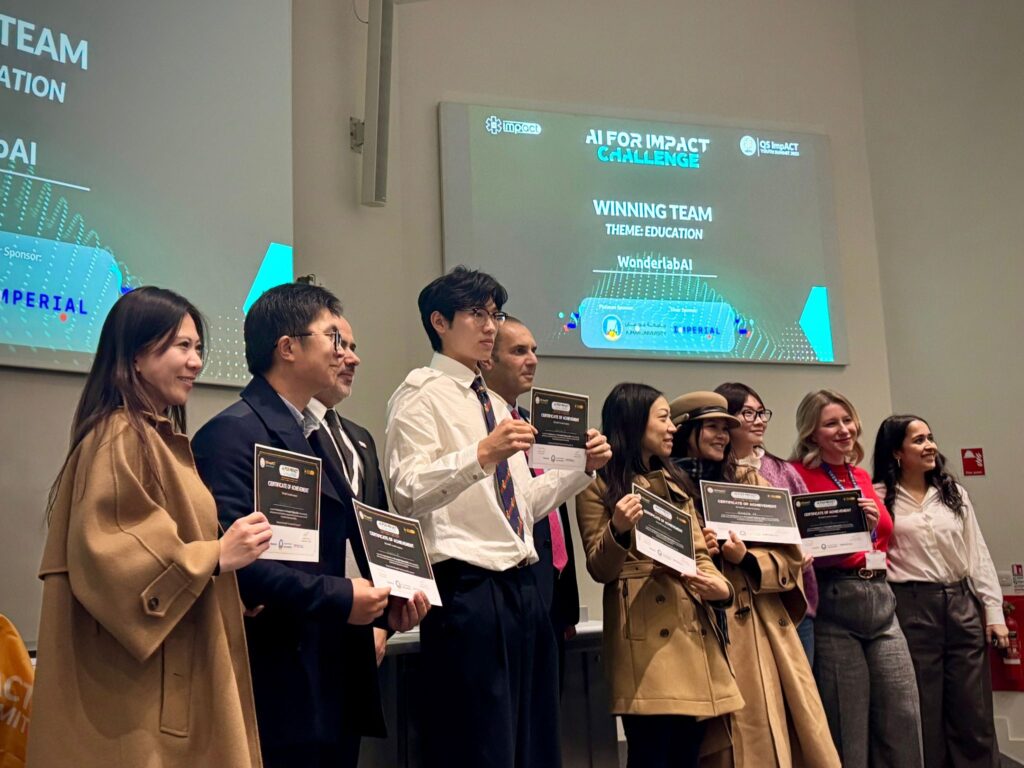
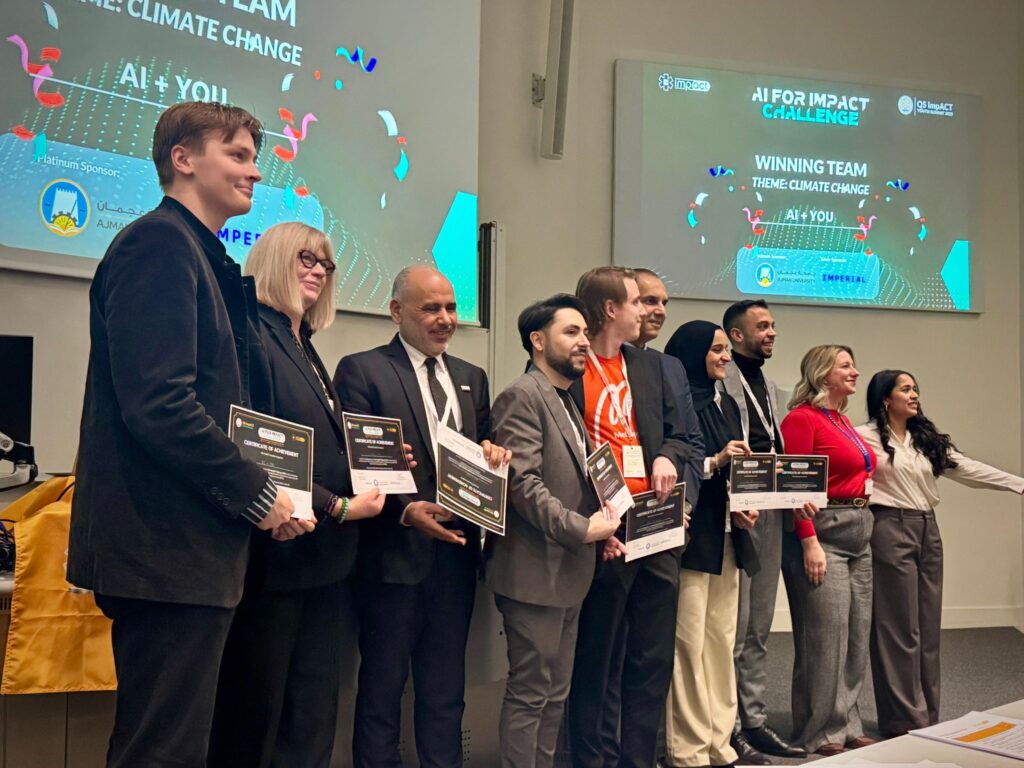
Together, these projects engaged nine UN Sustainable Development Goals: 3, 4, 6, 9, 10, 11, 12, 13 and 17.
Congratulations to the winning teams:
- WonderlabAI (Education): Kai Huang, Sky Luo, Tongtong Peng, Ziyi Song, Shery Tao and Ying Zhu
- Zippy: Dhruvi, Nitika, Naman Goyal, Rene and Seunfunmi
- AI + You (Climate Change): Khaled Mahfouz, Wessam Sheheib, Sana Abu El Nour, Leo Teräsvuori and Tommi Kela
Thank you to Aashna Shah and Olivia Herneddo, MFA, for hosting; Heather Haseley and the Imperial College team for the venue; Karim Seghir and Prof. Khaled Assaleh of Ajman University, our platinum sponsors; and the QS ImpACT team and jury for their thoughtful organization and deliberation: Buffy Price, Kinjal Dave, Paras Fatnani, Zoya Zaitseva, Ashwin Fernandes, Jenny Zapf, Ph.D., Krusha Khakhar and Sidharth Menon.
Day 2: The Youth Summit
On day two, young innovators from twenty countries stepped into the arena. They served on panels, shaped ideas at a hackathon, challenged assumptions and shared perspectives that reached well beyond the walls of the room.
Across every conversation, I heard a deep optimism about the future. Not a naive optimism, but the kind that grows out of lived experience, experimentation and care.
The winning concepts, for neurodivergent sensory spaces and intergenerational learning models, were especially powerful. They resonate strongly with the work we explore at ASU Next Lab to cultivate agency in students.


Thank you to every attendee who contributed energy, curiosity and voice. You made the day. And my appreciation to Aashna Shah, Olivia Herneddo, MFA, Confidence Mawusi and the organising team for creating a space where creativity and purpose could converge, and to Nunzio Quacquarelli, Zoya Zaitseva, Richard Kemp, Paras Fatnani, Jenny Zapf, Ph.D., Santiago Iniguez, Heather Haseley and Ashwin Fernandes. Well done, everyone.
Enterprise Technology at Arizona State University · ASU Next Lab